The Human Premium

The Human Premium
The 30-slide crime scene is dying.
Respectfully.
I judged a pitch competition last week. Same competition I have been involved with for years. Same basic format. Half a dozens of startups. Three minutes each. Founder walks up and tries to make the room understand why this thing should exist before the timer cuts them off.
Usually, you can feel the overload in the deck.
Fifteen ideas trying to fit into one rectangle. Market size. Product shot. Business model. Team. Traction. Roadmap. A screenshot from the app nobody can parse from the back row.
This year felt different.
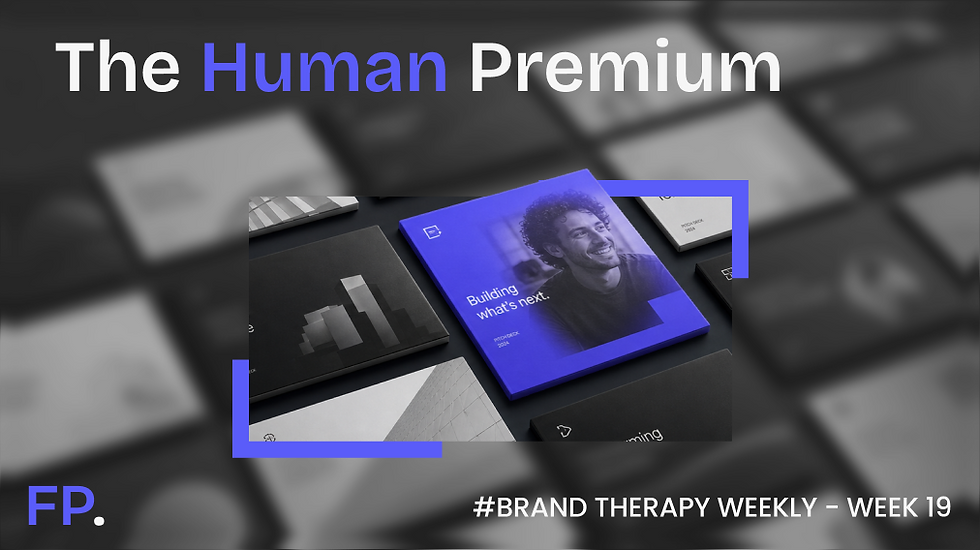
AI made everyone presentable.
The decks were cleaner. The pitches got to the point faster. The story moved with less friction. A few of them still had too many icons. A few still made the a few slides carry more than they should.
But overall, the floor moved up.
Not a little. A lot.
And that is the part worth paying attention to.
Credible is cheap now.
For early founders, this is genuinely useful. A team can go from messy idea to credible pitch deck in a weekend. Mentors can push the thinking. AI can help translate that thinking into a format the room can actually absorb.
That last part matters.
A pitch deck is not a storage unit. It is not where every thought goes to feel safe. It is a channel. Three minutes means the deck has one job: help the room understand the point before the founder runs out of oxygen.
AI is very good at helping people filter for the channel.
It can compress. Reframe. Cut the paragraph pretending to be a bullet. Turn the 2000-word slide into something a human eye can survive. Very generous of it.
Also deeply inconvenient.
Because when everyone can look credible faster, credible stops being the baseline.
The old signal was polish. Now polish comes in the starter pack.
For years, a decent-looking deck gave founders a little unfair advantage. Not because design magically made the business better, but because clarity and taste were expensive. You could spot the team that had help. You could spot the founder who knew how to package the thing.
Now the packaging is easier to access.
Not perfect. Not strategic by default. But good enough to raise the baseline.
That is good news for founders. It is also bad news for anyone who was using "we look professional" as the whole brand strategy.
Professional is the new minimum.
The human part got more expensive.
This is where my own work keeps shifting.
If AI can help a founder make a credible deck, website, logo direction, campaign concept, and miniature brand world faster than ever, then the value of the work moves upstream.
Less: can we make this look good?
More: why should this look like you?
That is a much harder question.
Because the thing AI cannot decide for you is the onlyness. The part that makes a founder, team, or brand feel specific enough that copying the surface would look ridiculous on someone else.
AI can make the outfit.
It cannot give you the personality.
It can make the deck feel premium. It cannot tell you whether the premium belongs to you, or whether you are wearing someone else's confidence because it came in a nice template.
You made it premium. Did you make it yours?
That is the question now.
And it is not a design question first. It is a trust question.
When the barrier to quality drops, our requirement for belief goes up. We start looking for the thing that feels harder to fake: judgment, taste, point of view, story, presence, contradiction, weirdness, the founder's real angle on the problem.
The stuff that used to feel optional because the deck was already struggling to be readable.
Now the deck is readable.
Great.
So what are we actually reading?
Everyone can look good. Fewer can feel true.
That is the human premium.
Not being messy on purpose. Not adding a candid photo because some brand person said humans convert better.
The premium is specificity.
The founder who knows what they are willing to be wrong about. The team that can explain the problem without sounding like they copied the category leader's About page in a moment of spiritual weakness. The brand that has enough self-knowledge to say no to the attractive option that does not belong.
This is the diagnostic work.
Not the logo work. Not the "make it pop" work. The part where you define what only this brand can mean, what it refuses to mean, and which kind of trust it is trying to earn.
That work has always mattered.
It just matters more when the room is full of good-looking decks.
I left the competition impressed. The founders were better prepared. The mentors clearly helped. AI clearly helped. The whole thing felt like watching the floor of entrepreneurship move up in real time.
Which is great.
Also rude.
Because now we have fewer excuses.
The work is no longer just to look credible.
The work is to become harder to confuse with someone else.
Right?
Frequently asked questions
Does this mean founders should stop using AI for pitch decks?
No. Use it. AI is excellent for compression, structure, first-pass clarity, and making the room do less work. The mistake is treating credible output as strategic identity.
What is the human premium?
The part of a brand that gets more valuable when quality gets easier to produce: judgment, taste, story, trust, presence, contradiction, and founder specificity.
Is polish less important now?
No. Polish still matters. It just stopped being rare. Once everyone can look credible, the question becomes whether the brand feels specific enough to believe.
Where does Brand Therapy fit into this?
The Brand Therapy process is diagnostic work. It helps define what only this brand can mean, what it refuses to mean, and which kind of trust it is trying to earn before the outputs multiply.


